

I kept my money in a savings account for three years in Germany — earning 0.01% interest. Zero. Point. Zero. One. Here's what I wish I had done instead.
I remember checking my Sparkonto balance one rainy Tuesday — oat milk latte in hand, obviously ☕ — and seeing that my "interest earned" for the entire year was something like 4 euros and 12 cents. Ummm… I expected a tiny bit more, to be honest.
I could not even buy myself a Brötchen with feelings of financial accomplishment for that.
And seriously… I felt smug about it for way too long. I mean, c’mon – I had a Sparkonto! And (!) was being responsible! So yeah, wasn’t I doing the adult thing?! 🤔
Except… I kinda figured out that I wasn't. I was just watching my money sit there, slowly losing value, while telling myself a story about being "careful."
Hm. I am not here to shame my past self or anyone else, but I want to share my experience, expectations, and wake-up call.
Can you relate? Or are you sitting there a lil' nervous right now, doing the maths on your own Tagesgeld balance 😂?
Spoiler: that nervous feeling? A lot of people know that’s totally normal.
And also – exactly the reason the fin:marie Investment Academy (LINK) exists. Because if nobody hands you the manual, we'll just write it together. In English. With zero jargon. But more on that later 🙂.
You Are Not Behind With Your Money (Even Though It Feels Like It)
Before we go any further – you are not late to this party, and for sure (!) you are also not the only one who didn’t start investing yet.
I know it can feel that way sometimes. Everyone around you seems to have a portfolio, a strategy, a Depot they casually mention at brunch like it's nothing. But try to think about all your friends – do they really all have a well-set-up fund? 🙂
Even though that’s not the point, because we don’t have to take anyone as an example, but rather focus on our own wishes, dreams and goals.
But, yeah… meanwhile you've got a savings account, a vague sense that you "should probably do something," and a drawer full of unopened bank letters in German you've been meaning to translate (with your last name pronounced in the wrong way – always one letter misplaced :D).
Btw… we've all got that drawer — mine is also where the plastic bags live, no judgment, please 😀.
https://giphy.com/gifs/moodman-monkey-side-eye-sideeye-H5C8CevNMbpBqNqFjl

This isn't a personal failing or anything. Nobody hands expat women a manual for German finance. We're translating tax forms, figuring out our Anmeldung, and trying to remember if we need a Berufsunfähigkeitsversicherung — investing genuinely falls off the list.
So rather time to give ourselves credit for what we all achieve by ourselves in a foreign country 👏.
We're in this together, and "starting late" is mostly a myth we tell ourselves to avoid starting at all. This is why I want to introduce a woman to you who is super close to mine and maybe also to your journey 🙂
Be prepared to…
Meet Priya
Priya, 34, is a UX designer in Hamburg. She moved from Mumbai five years ago, earns a comfortable salary, and — like a lot of us — had her savings parked in a Tagesgeldkonto "just to be safe." I know her from an Espresso-Coaching in fin:marie – this is one of those people with whom you directly click. I am sure you know that feeling 🙂.
https://giphy.com/gifs/cbs-ghosts-cbs-ghostscbs-6fRpsvvIVhBTaZaOLL

😜
So, next to very personal talks about all kinds of hobbies we share, we came back to what we initially wanted to talk about – her Money and how she can start investing 🤭.
I told her: “Here's the thing: in 2026, the average Tagesgeld account pays somewhere around 0.5% to 1.5% interest, depending on the bank. Inflation is running at roughly 3%.”

Ooops.
So even with that "safe" account, Priya's money was quietly losing purchasing power every single year — just more slowly than under the mattress. (Still losing, though. Just losing in slow motion.)
And also, I had to point this out to her, but I am going to repeat myself to her as this is very important: Priya didn't do anything wrong.
She just didn't know there was another option that wasn't "risky stock market gambling" — because that's usually how investing gets framed, isn't it? Either a painfully boring savings account or reckless casino. Nobody tells you about the very calm, very unglamorous middle ground: long-term, diversified investing.
Yeah, it made me very happy that Priya reached out to fin:marie to finally get her hands on investing her well-earned money properly. And I was SO ready to help her with my knowledge and giving her a first overview of her financial situation to, yeah – finally make the first steps in order to achieve the financial health she deserves.
Why Saving Alone Doesn't Cut It Anymore
And then she did something that honestly made me so proud — she signed up for the fin:marie Investment Academy.
Not because she suddenly felt ready (also: nobody ever does 🙃), but because she realized she didn't have to figure it out alone.
The Academy is where expat women like Priya – and like you – go from "I know I should do something" to actually doing it. In English, step by step, alongside a community that gets it. I may have done a little happy dance when she told me 💃.
I know, yes, I know. This is not exactly the topic you bring up in your most favorite coffee place with your two besties, Eleonora and Ruby.
https://giphy.com/gifs/cravetvcanada-happy-omg-3o6Zt8ZOI6kbLadD9u

But let's do the maths together – like pulling off a band-aid: quickly, painlessly:
- Savings account: ~0.5–1.5% interest, often below inflation — your money quietly shrinks in real terms
- Tagesgeld with the best rates: better, sometimes 2–4% as a new-customer promo — still rarely beats inflation long-term once the promo period ends
- Diversified ETF investing: historically averages 5–7% annually over the long term (with ups, downs, and zero guarantees, to be very clear
This isn't financial advice telling you to throw your Notgroschen into the stock market tomorrow…
https://giphy.com/gifs/baby-money-little-rascals-l0HFkA6omUyjVYqw8

– please don't 😅 (!) keep 3–6 months of expenses safe and liquid.
This is about the rest of the money. You know, the money sitting there "just in case," with no actual plan. Sounds familiar?
To understand the WHY – why you should not just let it sleep on your Sparkassen-Tagesgeldkonto (omg… those long German words, I can’t get over them 😂) – I will tell you now a bit more about the “Zinseszins”, the compound interest. This was also the trigger that finally convinced Priya to start investing.
The Zinseszins-Effekt — AKA Compound Interest, AKA Your New Best Friend
(… we still love Eleonora and Ruby of course, as – to be honest – he will not listen to your last romantic story and give advice 😀)
But as promised: Here's where it gets genuinely exciting (For real, stay with me).
Compound interest — Zinseszins, if you want to sound like you know what you're doing at your next team-building with your German colleagues – basically means your returns start earning their own returns.
Money making money making more money.
https://giphy.com/gifs/money-nwUE5rQ7vSNqg

It's the closest thing finance has to magic ✨ and it rewards exactly one thing: time ⏳.
Picture this: if Priya had invested 200€ a month starting at 34 instead of 39, at an average 6% return, those extra five years alone could add up to tens of thousands of euros by retirement — not because she invested more, but because her money had more time to compound.
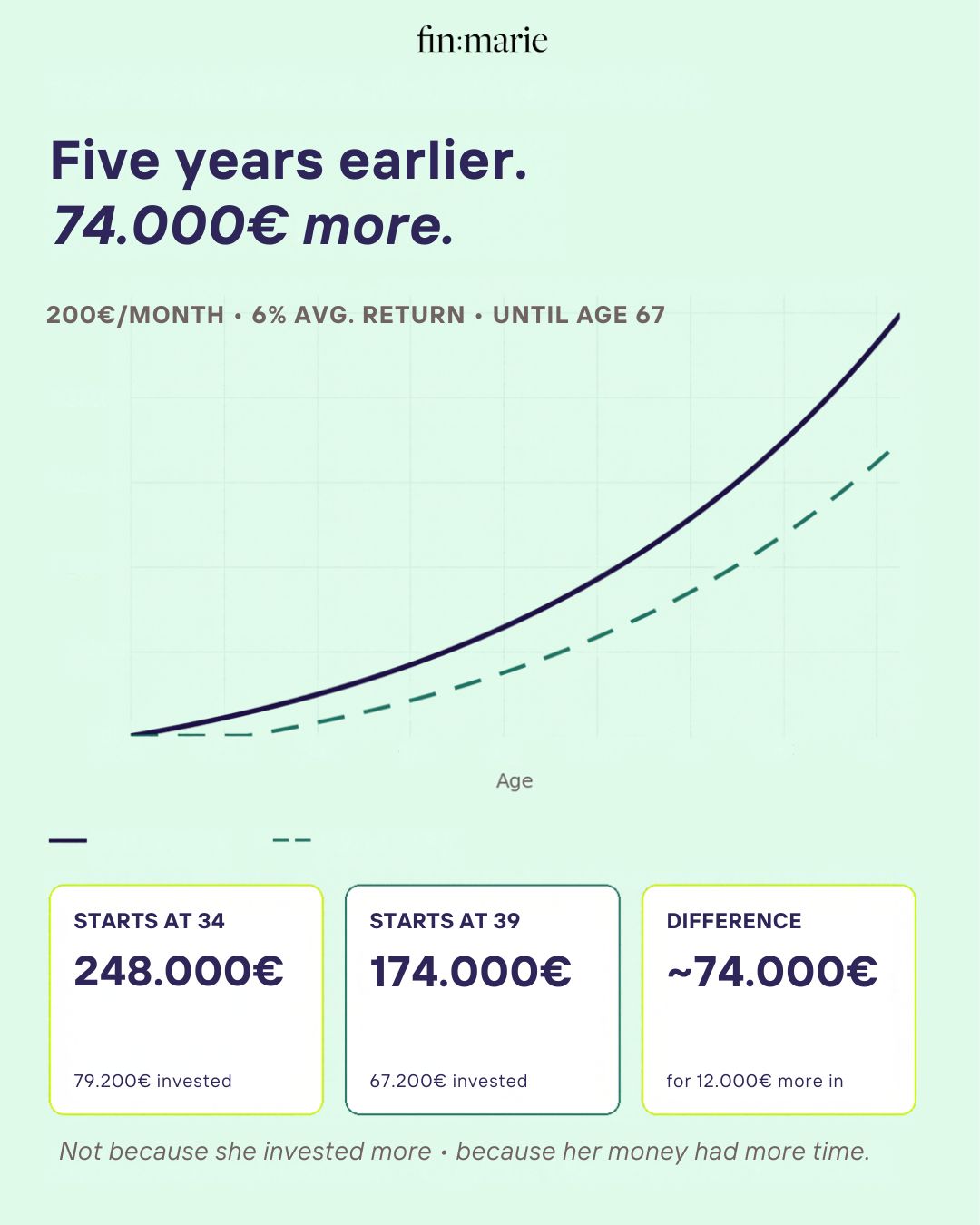
That's it. That's the whole secret. Not timing the market. Not picking the perfect stock. Just… starting. And letting time do the unglamorous, quiet work.
So Where Do You Actually Start Investing?
You don't need to become a finance girlie overnight (unless you want to, no shade either way 🙂.)
A few gentle first steps:
- Know your Sparerpauschbetrag: in 2026 it's 1,000€ tax-free on investment gains for single filers — file a Freistellungsauftrag with your bank so you're not taxed on returns you don't even have yet
- Keep your safety net liquid: 3–6 months of expenses in Tagesgeld, untouched
- Start small with the rest: a low-cost, diversified ETF savings plan (Sparplan) is the boring-but-effective entry point most of us actually need
If those three steps made your head spin a little — Sparerpauschbetrag, Freistellungsauftrag, Sparplan — breathe. This is exactly what we go through together inside the Investment Academy. Without any assumptions and skipped steps.
Just the stuff you actually need to know, explained in a way that finally makes sense.
✗ Don't / ✓ Do
Last but not least, the Do’s and Dont’s in a clear overview…
✗ Wait until you "understand everything" before starting ✓ Start small, learn as you go — the account doesn't care if you're an expert
✗ Keep all your money in a 0.5% savings account "to be safe" ✓ Keep your emergency fund safe, invest the rest with time on your side
✗ Go it alone, googling at 11pm, more confused than when you started ✓ Learn alongside other expat women who get exactly what you're navigating
okay, 🙂?
Let's Do This Together
That "okay, maybe I can do this" feeling? Follow it. 💛
The Investment Academy was built for exactly this moment — expat women, real questions, no jargon.
Join the Investment Academy (EN)